Follow us & Review



- I-Ching Acupuncture Clinic3609 W. Mukilteo Blvd.
Everett, WA 98203425-374-8408 - Edmonds Location7935 216th St SW Suite E
Edmonds, WA 98026425-672-2113 - Torrance, CA Location20911 Earl St.#330
Torrance, CA 90503310-540-0300 -


Health WellNews
Speedy Spring Cleaning Tips
In Traditional Chinese Medicine (TCM), all of life is influenced by seasonal cycles. You are probably Most people love a clean house but few people have time to do a deep clean. The days of spending a week thoroughly cleaning your home are gone.
It’s unfortunate. Spring is a great time for cleaning. Feng Shui (the Chinese study of harmonizing your environment) recommends spring cleaning, not only because it’s nice to live in a clean house, but also because it increases the Qi of your home. Living in an environment of healthy, balanced Qi supports your health and happiness.
It’s possible to have a clean home without spending days cleaning it. Follow these professional house cleaning tips to get your house sparkling in record time.
- Simplify your cleaning products. Most cleaning only needs two solutions: an all-purpose cleaning solution and a window cleaner. This means you only need to carry two bottles and some rags.
- Use a tool-belt. Use a tool or garden belt to keep your supplies handy at all times. If you simplify your cleaners, you’ll need a pocket for some rags and two loops to hang the spritzer bottles.
- Have a large supply of rags. Instead of rinsing your rag when it gets dirty, get a clean one. When you are finished, throw all the rags in the washer at once.
- Work clockwise. Begin directly to the right of the door. Work high to low and circle the room clockwise. For example, dust top shelves before the lower ones; wipe counter tops before baseboards. Be very systematic—don’t jump ahead or backtrack. Clean top to bottom and when you finish one patch, move to your right to do the next. You’ll finish the room in one cycle.
- Clean all aspects of a room in a single cycle. Dust, wipe and do windows in one pass. Make sure that you have all your supplies in your belt before you begin.
- Vacuum or sweep the floor last.
- Soak your tub. If your tub or shower has soap scum built up, spritz with white vinegar 10 minutes before you get to the bathroom to allow time for it to soak.
- Use a squeegee. Squeegees make window and mirror cleaning fast. For the best results, use a professional-grade squeegee. After you squeegee your window, use a dry rag to clean up the edges. If the surface has sticky dirt, use a rag to scrub the window before squeegeeing.
- Collect your clutter. Use a laundry basket to collect items that need to be returned to a different room. Move the basket from room to room and only empty it when you are finished.
- Clean inside to out. Clean the inside of the toilet before the outside. When you clean the outside, start from the top of the tank and work down. Use a rag until it is dirty. Throw the rag in a pile to be washed later—don’t take time to rinse it.
Green Cleaning Products
Some of the strongest toxins in your home are from cleaning products. And sadly, most cleaning jobs don’t even need them.
Mix your own cleaning products to keep your home fresh and healthy.
All-purpose cleaner: Mix ½ cup white vinegar (or use the citrus vinegar below), one teaspoon castile soap, two cups water and 15 drops of essential oil. Shake to mix the essential oils with the water. Add tea tree, lavender or lemon essential oils to boost the germ-killing properties.
Window cleaner: Mix ¼ cup white vinegar and two cups water. Use in a spritzer bottle. For best results, wipe with a squeegee.
Scrubbing powder: Mix baking soda with water to make a paste. Scrub. Use this on sinks, countertops and dishes with stubborn, baked-on food.
Mineral deposits: Use vinegar to get rid of mineral deposits in your sink, toilet, showerhead—even your coffee maker. Spritz the surface with white vinegar. Allow the vinegar to penetrate and wipe away. Depending on the buildup, you may need to reapply. Sometimes you can spritz and then scrub with baking soda to remove chunks of deposits.
Air freshener: Use essential oils to make your home smell fresh. Try lemon, orange or grapefruit for an uplifting scent.
Homemade citrus cleaner: Peel oranges and put as many peels as you can in a quart jar. Fill the jar with vinegar and let sit for two weeks. Strain the peels and use the orange-scented vinegar in your cleaning products.
What You Need to Know about Food Allergies
Food allergies are common these days. In fact, the Centers for Disease Control and Prevention reported that food allergies among children increased approximately 50% between 1997 and 2011.[1]
No one knows why food allergies are increasing, although several theories exist. This leaves doctors and scientists unsure about what to recommend in order to prevent them.
In contrast, Traditional Chinese Medicine (TCM) has a strong grasp of allergies. From a TCM perspective, many allergies are caused by a Wei Qi imbalance. Wei Qi is similar to the Western medicine view of the immune system; Wei Qi defends the body against foreign substances.
And unlike Western medicine, TCM recommendations for food allergies are always individualized. Your specific diagnosis impacts your treatment plan and how you will balance your immune system.
Until you get a personal diagnosis, use these tips to control your food allergies.
- See an allergist and get tested to learn exactly what you are allergic to.
- Avoid your food allergens, especially if you are exposed to multiple allergens at once. For example, you may be more sensitive to your food allergens when you have hay fever.
- he most common food allergens are peanuts, the proteins in cow’s milk, shellfish, tree nuts, fish, eggs, gluten, wheat and soy. These are good foods to avoid if you don’t know exactly what you’re allergic to.
- Ask about ingredients when you eat at restaurants or when your meal is prepared by someone else. Don’t be shy to get specific.
- Read labels to make sure there aren’t any “hidden” ingredients you’re allergic to.
- Sometimes people outgrow food allergies. Talk to your allergist to get tested if you believe you’re no longer allergic.
- Eat foods that nourish your immune system. Cauliflower, Asian pears, water chestnuts and white cabbage are good antioxidants and support your Wei Qi. Be sure to eat both omega-3 and omega-6 fatty acids. These fatty acids are found in salmon, tuna, mackerel and other cold-water fish.
[1]http://www.cdc.gov/nchs/data/databriefs/db121.htm
Dandelion Pesto
Makes 2 cups
- 12 ounces washed and cleaned dandelion leaves
- 1 cup olive oil
- 4 cloves garlic, peeled
- 6 tablespoons pine nuts, lightly toasted
- 1 1/2 teaspoons sea salt
- 2 1/2 ounces Parmesan or Romano cheese, grated
- Put one-third of the dandelion greens in a food processor or blender with the olive oil and chop for a minute. Add the remaining dandelion greens in two batches until they’re finely chopped.
- Add the garlic, pine nuts, salt and Parmesan, and process until everything is a smooth puree.
- Taste; add more salt if necessary. Thin with olive oil or water if needed.
Storage: The pesto can be refrigerated in a jar for up to 4 days or frozen for up to 2 months. To prevent the top from darkening pour a thin layer of olive on top.
Acu 101: The Eight Principles
When you go to an acupuncturist, have you noticed that the way they describe your illness is different than the way your doctor describes it?
Traditional Chinese Medicine (TCM) looks for patterns of imbalance. Identifying these patterns allows your acupuncturist to form a TCM diagnosis and leads to your treatment. Because of this, illnesses that western medicine considers unrelated may be considered similar by your acupuncturist.
There are several systems for viewing these patterns. One of them is called the Eight Principles. In this system, four sets of qualities help define your illness.
- Interior/Exterior. Your acupuncturist will look at your illness and determine if it is located in an interior organ or if it is caused by an exterior pathogen.
- Hot/Cold. Your acupuncturist will determine if your imbalance is hot (like a fever) or cold (like chilliness).
- Full (excess)/Empty (deficiency). Your acupuncturist checks the strength of your Qi and whether there is a pathogen present.
- Yin/Yang. Your acupuncturist determines if your condition is primarily yin or yang in nature.
How can the Eight Principles Help You?
If you’re not familiar with TCM, getting a diagnosis of “excess heat in the interior” won’t mean anything to you. But remember, the Eight Principles are patterns of imbalance.
Ask your acupuncturist what your diagnosis means. Then ask what symptoms point to that diagnosis.
Start observing your everyday complaints, aches, pains and health challenges. Notice if you regularly have symptoms that point to the diagnosis. It’s likely that you will start to see patterns in your symptoms, even if western medicine doesn’t understand the links between them.
Once you know your constitutional tendencies, you can begin a long term plan to balance your body and prevent illness.
Acupuncture 101: Kidneys
Winter is the season for the kidneys & bladder.
In Western medicine, kidneys are the organs that filter and purify blood. They maintain pH, mineral and electrolyte balance by removing excess water and salts to create urine. The urine is then stored in the bladder until you pee.
In Traditional Chinese Medicine (TCM), the kidneys and bladder are seen as an energetic system, bigger than just the physiological function of the organs themselves. To TCM, the kidneys govern reproduction, produce bone marrow, influence growth and development and control sexual energy.
From a TCM perspective, there are several kidney functions that differ from a Western perspective.
Like in Western medicine, the kidneys are responsible for water metabolism. However, instead of understanding water and salts from a bio-chemical perspective, TCM describes fluid as clear or turbid. Clear fluid is lighter and the kidneys send it upward to moisten the lungs. Turbid fluids are heavier and they are sent downward to be released through the bladder.
One of the kidneys’ primary roles is storing the vital essence called Jing Qi. Jing is the essence of Qi and is responsible for reproduction and regeneration. There are two types of Jing—the Jing inherited from your parents and forming your basic constitution, and the Jing acquired from the food, water and air of your daily life. The kidneys store and control Jing, and this process influences growth and development, sexual maturation, reproduction and aging.
The kidneys are also in charge of “Zhi”—mental drive and courage. Zhi is the will to live and provides determination and focus to accomplish your goals and realize your dreams.
It’s important to provide care and nourishment to your kidneys. Eat warming foods, and avoid raw foods and cold drinks. While a green salad is OK now and again, winter is not the season to be salad-crazy. Eat soups and stews. Add extra root vegetables, squash, beans, miso and seaweed to your diet. Use garlic and ginger for flavor. If you want fruit, eat blueberries or blackberries.
And keep your kidneys warm. Wear long shirts and sweaters that come down to your hips. Better yet, make a haramaki (see sidebar) and wear it every day.
A Simple 4 Step Plan to Find the Time to Relax
Winter is a time to stop, pause and reflect. Your body and soul need a break from to-do lists, urgent priorities and busyness. It’s important.
But finding time is difficult. The whole reason you need a break from busyness is because you are so busy.
Making time to relax doesn’t have to be hard. Follow this simple 4 step plan and you’ll discover time you didn’t know you had. continue reading
Winter Feng Shui for a Healthy Home
In Traditional Chinese Medicine (TCM), all of life is influenced by seasonal cycles. You are probably familiar with this in acupuncture, but did you know that these cycles also affect your home?
The practice of making a home “healthy” is called Feng Shui. By directing the flow of Qi through your home in a balanced way, you can create an environment that promotes health and happiness to everyone who lives in it. Feng Shui gives rules to harmonize yourself with your home.
There are many ways that Qi is balanced in a home. Choosing harmonious colors, shapes and symbols, placing furniture auspiciously or strategically hanging wind chimes or mirrors are all typical Feng Shui practices. continue reading
Acupuncture 101: Understanding the 5th Season
In Traditional Chinese Medicine (TCM), late summer is a separate season.
But from a Western perspective, it doesn’t make sense. First of all, it’s a short season—from around the third week in August to the September equinox. And usually there’s nothing distinctive about late summer weather that makes it different from summer or fall.
Why have a fifth season?
Nature gives us the answer.
TCM is governed by the 5 elements, which represent the cycles of nature. Every plant and animal goes through the cycle of birth, growth, maturation, harvest and storage. Late summer corresponds to the “mature” part of the cycle. Plants are at their peak—fully mature with ripe fruits. It’s not quite harvest time, but it’s past the peak growing season.
One important quality of late summer is its transition from yang energy (active, hot and extraverted) to yin (reflective, cool and introverted). This pattern happens naturally. School resumes. People refocus on their routines. It’s a great time to reconnect with home and family. Even if you don’t identify late summer as a separate season, you probably make this transition anyway.
The earth element guides late summer. Its organs are the stomach, spleen, pancreas and muscles. Its color is yellow/orange and its taste is sweet.
Digestion is especially important in late summer. Pumpkin, squash, sweet potato, peaches, dates, apples, cherries, millet, almonds and coconut are all recommended late summer foods. While these foods have sweet flavors, remember that too much sweetness is not healthy. A big bowl of ice cream is still not a health food—even in late summer.
Earth guides our ability to think clearly. An imbalance in earth can lead to worry or obsession, but balance in earth gives a sense of calm, clarity and adaptability. Late summer is an excellent time to start or recommit to a meditative practice. By taking time quiet time, your daily activities will be more productive.
The emotions of earth are sympathy, compassion and nurturing. If you have considered volunteering, late summer is a good season to make that intention real.
Homemade Fruit Roll-Ups
Ingredients
• 2 ½ – 3 cups ripe or slightly over-ripe fruit, peeled and diced
• Sweetener to taste: honey, sugar, agave, etc.
• 2 teaspoons fresh lemon juice
Instructions:
Preheat oven to lowest temperature,
usually 140° – 200°F
Puree the fruit in a food processor until smooth. Taste and add the sweetener. Remember—the flavor will concentrate as the leather dries, so be sparing. Pour the mixture onto a baking sheet lined with plastic wrap or a silicone baking mat (don’t use foil, parchment, or waxed paper). Spread evenly so it is 1/8” thick. Bake for 6-8 hours until the center is not tacky. Remove from oven and peel off plastic wrap or baking sheet. Cut into strips. Store in airtight container
or freeze.
Tips:
• Suggested fruits: plums, peaches, nectarines, apples, strawberries, raspberries, grapes,
or mangos.
• The addition of sugar or honey enhances the texture and makes the fruit roll-ups chewier.
• If using plastic wrap, it will shrink a little as the fruit dries, so leave a little extra around the edges.
How to Pick a Health-Friendly Office Chair
If you work in an office, it’s likely you sit all day. You probably spend hours and hours in your chair—rarely giving thought to the chair that’s holding you up.
But if you were training for a marathon and spent hours running, wouldn’t you buy good
running shoes?
Choosing an office chair can make the difference between coming home exhausted and in pain, and coming home invigorated. Here’s what to look for in a good chair.
- Chair Shape: Choose a chair that follows the contour of your spine—especially if you are shorter or taller than average.
- Lumbar Support: Test the lumbar support to make sure it fits snug against your lumbar, giving support to prevent slouching or tension.
- Arm rests: Look for adjustable arm rests that adjust up and down as well as in and out for different body widths. Align the arm rests so that they support the weight of your arms when your arms extend down naturally from your shoulders.
- Adjustable seat height: Adjust the seat height so that your arms extend to your desk at 90° angles. Depending on your leg length, you may need a foot rest to support your legs so that your thighs are parallel to the ground.
- Seat length: Sit on the chair with your bottom against the back of the chair. The seat length should be 2-3 finger lengths between the end of the chair and the inside of your knee.
- Seat cushion: Make sure the seat is comfortable.
Once you have your seat adjusted for good body posture, you’re ready for the final step for healthy office posture.
Raise your computer screen so you can see it with your head in a neutral position. This usually means that your keyboard must be separate from the screen. If you use a laptop, put the laptop on a stand and use a separate keyboard on your desk when typing.
Pain Reducing Desk Stretches
A regular routine of stretching will relieve aches and pains and help prevent office injuries.
- Start with a simple head roll—head forward, to the side, back, to the other side and back forward again. The slower the better. Reverse.
- Shrug your shoulders and roll them forward and backward.
- Reach up and then back, touching your back with your right hand as far below your neck as you can. Use your left hand to gently push your right elbow farther behind your head. Repeat on the other side.
- Clasp your hands and turn them so your palms extend in front of you. Extend your arms forward and then above your head.
- Extend your right arm in front of you, with the fingers pointing up and palm forward. Use your left hand to gently pull the fingers toward your body. Repeat on the other side.
- Cross your right leg over your left one. Twist to the right, using your left arm for leverage against your right knee. Repeat on the other side.
- Sit on the edge of your chair, legs extended in front of you (make sure the chair is secure if it has wheels). Gently reach for your toes. If you have back issues, use your desk or a wall to support your body weight as you gently reach forward. Hold and breathe for 10 seconds.
- Walk around. Find reasons to make small trips away from your desk. Any movement is better than no movement.
Helping Teens Beat School Stress
With the start of the school season, many teenagers are again feeling the increased effects of stress. And while adults have many resources to help with stress, teenagers have few. Their stress is high, but their ability to cope is low.
Many schools are recognizing this and taking steps to help their students. Some schools have yoga programs or use therapy dogs. Some teach Transcendental Meditation or Mindfulness Training. More and more schools understand that teaching stress management is an important part of preparing teenagers for life.
If you have access to classes that help with stress, consider offering them to your teen. But even without classes, there’s a lot you can do to help your stressed teen.
Points Towards Health
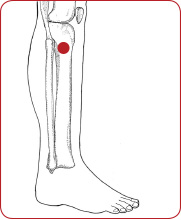
Three Mile Point (ST 36)
Location: Four finger widths below the kneecap, one finger width to the outside of the shinbone. If you are on the correct spot, a muscle should flex as you move your foot up and down.
Function: Strengthens the whole body, especially the immune system; tones the muscles and aids digestion as well as relieves fatigue.
Watch for signs of stress. Fatigue, headache, feeling sick, mood swings, changes in sleep or eating patterns, a drop in grades or difficulties in relationships can all be signs of stress. Address stress before it is a serious problem.
Be available. Even if you are busy, make time to spend with your teen—especially the times your teen is most likely to open up (bedtime, driving, etc.)
Soften your reactions. Teenagers are very sensitive. Express your opinions without judgment or argument.
Listen and translate. Sometimes teenagers can’t accurately describe how they are feeling. Sometimes “no one likes me” or “I’m stupid” means “I’m stressed and worried.” Help them identify feelings of stress so they know how to care for themselves.
Listen and illuminate. Sometimes teenagers lump feelings into a big pot and draw grandiose conclusions. “My teacher hates me” can mean that the teacher was just grouchy. Help your teenager separate real events from imaginary ones, real conflicts from misunderstandings.
Stop rushing. Remember that you may be hearing only part of the story. It may take time for a teen to relax enough to speak openly. Be available for long conversations.
Facilitate support from friends. Encourage your teenager to spend time with supportive friends and family.
Teach self-care. Encourage your teen to exercise and eat well. As challenging as it may be, talk about the benefits of a full night’s sleep. Point out that it feels good to feel good.
Teach time management. Teens are not likely to ask for help managing their busy schedules, but sometimes they need it. Encourage them to think of ways to complete their work without stress.
Ask your teen what they need. Do they need advice or just someone to listen? Do they need strategies or loving support or active intervention? Allow your teen to identify what would
be helpful.
Stop being helpful. Sometimes extra advice, strategies or tips just give the teen more things to worry about. Remind the teen that they are doing great.
Allow alone time. Sometimes being alone, watching YouTube or playing computer games is a way for teens to unwind. Understand that they need to relax, even if you don’t enjoy the activity.
Sun Safety Tips
It’s summertime. It’s time to get outdoors and enjoy the sun.
Follow these sun safety tips to protect your skin and avoid a nasty burn.
- Cover up. Wear clothes and a hat to protect your skin.
- Find shade. Instead of spending all day under the hot, beaming sun, spend part of the day in the shade. If no shade is available, bring an umbrella or tent.
- Avoid the noon sun. Ultraviolet (UV) radiation peaks at noon, when the sun is highest in the sky. Time your fun in the sun for early morning or late afternoon when the sun is less intense.
- Wear sunglasses. Protect your eyes from UV radiation.
- Choose sunscreen wisely. Not all sunscreens are made the same. Use the tips below to pick the best sunscreen.
- Put on sunscreen before getting dressed. If you apply sunscreen around clothes, you may miss a spot.
- Apply sunscreen to all exposed skin—including your part or bald patch. Any skin can burn in the sun.
- Allow 20 minutes between applying sunscreen and going outside. This allows the sunscreen to penetrate the upper epidermis of the skin.
- Buy new sunscreen every year so the ingredients stay fresh and potent.
- Protect children, especially babies, from the sun. Their skin is extremely vulnerable
Sun Protection Do’s and Don’ts
Do:
- Do use products with zinc, titanium dioxide, avobenzone or Mexoryl SX. These ingredients give good sun protection without penetrating the skin and entering the bloodstream.
- Do use sunscreen creams or lotions.
- Do use broad spectrum protection.
- Do use sunscreens labeled “water resistant for beach, pool and exercise.”
- Do use SPF 30+.
- Do reapply often.
Don’t:
- Don’t use products with vitamin A (retinyl palmitate). Vitamin A is good to eat but studies show it is harmful on your skin.
- Don’t use products with oxybenzone, a synthetic estrogen that can enter the bloodstream through the skin.
- Don’t use sunscreens with added insect repellent. Apply insect repellent separately. Put it on before your sunscreen.
- Don’t use sprays or powders. Sprays and powders release sunscreen particles that may not be safe to breathe.
- Don’t use SPF above 50+. High SPF numbers are misleading. They may tempt you to stay in the sun longer, exposing you to types of skin damage other than sunburn.
Points Towards Health
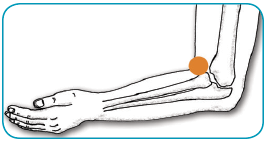 Location: At the outside edge of the elbow crease
Function: This is a great point to alleviate heat in the body. It is especially helpful in reducing skin irritation and inflammation, and can be used to alleviate itching. This point is also helpful for burning diarrhea, hot flashes, heat stroke and hives.
Also good for arm, shoulder and elbow pain.
Use this acupuncture point if you have red, itchy, oozing and inflamed.
(ie. Poison Ivy)